
@moderator
Forum Replies Created
-
AuthorPosts
-
 ModeratorKeymaster
Hi Duncan –
Glad you found the Facebook group – this is the same one that had already been introduced in this topic.
I see there is some good conversations going on there, glad to see that happening.
I’m not a Facebook user myself, but I am told that things can easily get lost in Facebook groups as time goes by. And so it seems as I scrolled down through the recent activity – is there any organization to those endless discussion threads?
It might be a logical division to use Facebook to post owner sagas, which is an easy place to upload photos, etc.
But if you want to save a comment for reference by a future owner, then this site might be preferable.
But as I said, I don’t use Facebook so maybe I’m wrong.
Cheers – Marilyn, moderator
ModeratorKeymasterI’m sorry to those who just posted. John is no longer a forum member. I will work to update this forum to eliminate those who joined as being “Interested in a Nic 38” and no longer are.
Marilyn, moderator
ModeratorKeymasterI’m sorry to those who just posted. David Smith is no longer a forum member. I will work to update this forum to eliminate those who joined as being “Interested in a Nic 38” and no longer are.
Marilyn, moderator
ModeratorKeymasterOh yes, I forgot to mention that – we had an aluminum backing plate below deck that was below the plywood “core”. Ours was corroded too, so the new FRP plate is the replacement for the aluminum plate as well as the deck strengthener.
Thanks for clarifying the existence of the aluminum backing plate.
Marilyn, moderator
ModeratorKeymasterJonathan Carr now owns Echo Papa, hull #86. The membership directory has been updated.
Congratulations Jonathan. Keep us up-to-date on your restoration project.
ModeratorKeymasterThanks for setting up the facebook group, James – happy to help owners connect using their preferred method.
For those who do start to use the facebook group regularly, if you are reporting there on a project that you think users here would find interesting, please make a short posting on this site to alert everyone who may be interested in joining/reading the facebook group.
I’m sad that I’ve never made it easy to post photos etc. on this forum – not enough time in my days! If there is a forum member with WordPress/BBPress experience who would like to volunteer to make this forum more user friendly, please contact me directly. I’m happy to have another help me manage this website. Write me at moderator @ nicholson38.org.
Cheers! Marilyn, moderator
ModeratorKeymasterWe decided to make our own, and they turned out well. Here are some notes for those who choose to make replacement cockpit covers yourself.
– Think hard about what you want in your cockpit covers, don’t just repeat what is there. Do you want more zippers? In different places? Where does rainwater get inside? For example, we routed the canvas outside the support post to try to control rain water leakage better, the existing canvas went inboard of the support post. Not sure of the original CN design.
– If you are going to do this yourself, a strong walking foot sewing machine is extremely useful. Straight stitch is enough, but for future sail repair, a walking foot zigzag machine is worth the extra cost. If you are going to hire someone, make sure they have regular access to the boat. See next point.
– I used the existing canvas as a rough pattern, but chose carefully the order in which I sewed things and regularly checked the fit on the boat at specific checkpoints. This step-by-step checking was vital to get a tight fit – patterning precisely is hard when any wrinkle will result in flogging canvas or puddling rainwater.
– We added a narrow outside flap over each zipper to try to direct water over the zipper. Think hard about the water flow patterns to ensure the flap directs water over the zipper, rather than acting as a dam to hold draining water at the zipper. We also added gussets in various places (e.g. winch area) to direct water away from coaming.
– Sailrite.com is a great place to shop for the fabric and notions. This is what I purchased:
–canvas fabric: Weblon Regatta® Ivory 62″ Vinyl Fabric, 5 yds – this is tough stuff with a nice hand for canvas. Does not need edge finishing. Good dimensional stability. An alternative would be the Shelter-Rite® fabric, but it is much stiffer – perhaps it’s best used for chafe protection.
–chafe protection: Shelter-rite, 1 yd. I sewed this onto the canvas in various places where chafe could be a problem, for example at the main sheet entry into cockpit.
— Regalite® 30 Gauge Vinyl Window Material 29″ x 68″ Clear – I got 2 pcs of this, which was enough for 4 side windows (2 each side) and 3 aft windows. I wonder if I will wish I got the 20 gauge, time will tell. The 30 gauge is stiffer than the canvas fabric.
–Keder Awning Rope White 5/16″ – for the boltrope to run through the upper track.
— Flex-A-Rail White 44″ Long – for the upper track attached to cockpit hard top. This was how our old canvas was attached, and some need replacing. This requires special screws with unique heads for mounting, get those too.
— YKK® Finished Zipper #10 White Double Pull (Vislon) with the YKK® Continuous Zipper #10 White (Vislon). Try to find a double pull without a locking tab. You want to be able to pull with equal ease from either inside or outside. See next comment about why you might also want an opening zipper.
— Loxx® Pull It Up Fastener Cloth-to-Surface Oval Plate Stud Set (Nickel) – we used opening zippers just forward of the metal support post so we can remove sides separate from aft. We used the Loxx fastener to keep tension above support posts and take pressure off the opening zipper. The stud is screwed to the hard top, the fastener attached to the canvas via a tab.
— Webbing Tubular Polyester 1″ White 2700# – sewn at canvas bottom as a strengthener for the D-rings, see next note. Also used to create tabs for Loxx fasteners describe above.
— D-Ring Sewable Nylon 1″ Black – used about 40 of these to make canvas lower tie-down points using bungee.
–Seamstick 3/8″ Basting Tape for Canvas – to hold things together before sewing. Vinyl canvas is not forgiving when seams must be torn out (it leaves a bunch of needle holes in your “waterproof” fabric), so it’s vital your goal is to stitch once in the right place.
— Seams can be sealed with HH-66 Vinyl Cement – but I really do NOT recommend this. The cement coating goes black with mildew very quickly and makes our seams ugly. The fabric and fit looks great after a couple years in the tropical sun.
I can provide pictures if someone interested in making their own canvas. This was time consuming but rewarding boat task because it is exactly what I want with a reasonable material cost of about US$400.
Marilyn, moderator Nicholson38.org and co-owner of Rainshadow, Nic 38.
ModeratorKeymasterPat – can you please tell us why your steering failed? Do you still have the original mathway steering?
Sounds like a failure other owners might be able to learn from.
If you want to answer, please start a new topic under ‘Steering and Rudder”.
To do that,
– go to this page,
– scroll down until you find the “Create New Topic” box.Making a new topic will help everyone find your answer, rather than leaving it buried in this topic conversation.
Thanks – Marilyn, moderator
ModeratorKeymasterNB. This post is from Roger of Race Passage. I added photos to it for him. Moderator
****
Good day,
On refitting prior to ‘off shore’ installed a Gaurhauer solid boom vang.
Just the job as it does away with the topping lift which I left in case of requiring a lift and having one mainmast winch handy.
Oh-one thing, unsure if available in Europe!
Cheers
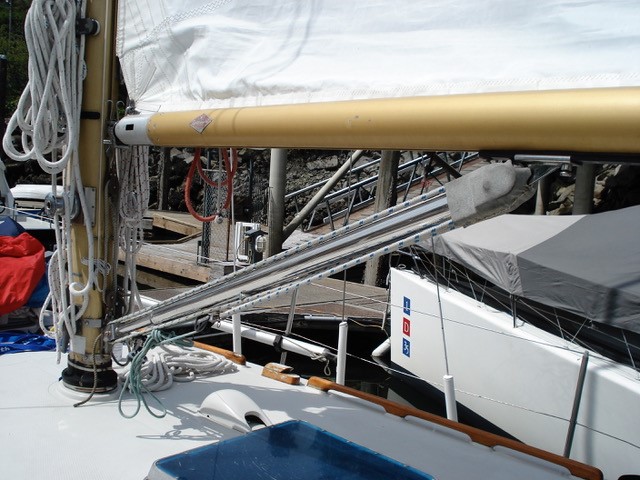
As attached to mast
 ModeratorKeymaster
Sorry, I cannot offer much help. All I know of her history comes from the owner list that Jeremy Lines shared with me in 2012.
Hull #27 was named Pinta from launch in 1969.
First owner was H.A.S. Murray from 1969-2005, location not recorded.
Second owner was P. Chafer from 2005-2008?, location Algarve
Third owner was Eddie Todd from 2008 – ??, location not recorded.None of these previous owners were members of this forum and I do not have any contact info. However, I believe Eddie Todd may have been part of the email group that was used to communicate before we setup this website in 2010.
Does any long time owner have email addresses saved from that former email group?
Thanks, Marilyn moderator.
ModeratorKeymasterOK, something has gone wrong with Nick’s posting, which was here and now is gone…..
But anyway, Nick asked where to find the article. It’s in the May 2020 issue of Sail magazine, which is available for purchase here.
In addition, the article is now available for online for free:
https://www.sailmagazine.com/cruising/sailing-the-inside-passage-to-the-pacific-northwest
Enjoy the nice photos taken by Van.
And just in case the article inspires you to cruise the Inside Passage, you can buy my guidebook on Amazon.
Marilyn
ModeratorKeymasterWe have a chain brush that wraps around chain and “scrubs” it while being hauled up. We use a boat hook to hold the brush just below the waterline while the windlass hauls. This gets off small bits. BTW – this chain brush is made by Davis but I think it’s a discontinued product. I’ve never seen another one like it either. Ours came with the boat, and when it breaks we repair it. Handle thing indeed!
Back to hauling up the anchor – larger seaweed bits that make it up to deck level get picked by hand (with the windlass stopped).
The muddiest bit (like the anchor) gets hand dunked multiple times.
Depending on the anchorage bottom, the chain can be smelly for a day, but it gets a nice bath at the next anchorage. I don’t find it to be a problem. We don’t anchor in muddy bottoms much.
Our anchor locker is in the forward-most bow section, not the original locker further aft that has the chain fall through the berth cushions. This is both good and bad. The good is that the chain doesn’t sneak between the cushions. The bad is that there is more weight further forward and higher (not ideal for boat trim) and the slope of the bow is not enough for the chain to always fall nicely (sometimes it needs a tug from below – hassle!).
Marilyn, moderator
ModeratorKeymasterHi Kenneth –
Just to add a few more thoughts, based on your last comments.
If you search the our forum for bow thruster, you’ll find that many people have them and like them. (e.g. here.) There is a lot of windage on the Nic 38 so is easily blown about if you are not aggressive with the engine. (as discussed here.)
Also search for “single hand” and you’ll see that people who sail solo have made modifications to run the lines aft, which I suspect is tricky do to the fixed windscreen. If you have an autopilot you trust, you could go forward to manage the sails.
Our Nic 38 still requires going forward for most sail handling. Just like how she was built, all halyards are at the mast and reefing is done from the deck. We did add slab reefing rather than use the old-style roller reefing. And we added a roller furler headsail, but still have a solent stay that uses hank-on headsails.
Most boats that are 50 years old have had considerable modification by past owners. For example, our aft cabin looks nothing like the original as PO completely modified it.
Good luck finding the right one for you.
Marilyn
ModeratorKeymasterI’ll take a shot at answering those questions:
1) A 50 yo boat as well-built as the Nic 38 is likely more affordable to service than a more modern boat for a variety of reasons.
a) Nic 38 has solid hull, glassed deck-to-hull join, most the deck is solid (the cabin top is not, and under the mizzen mast has been a weak point for Nic 38 with teak decks). Most newer boats have thin FRP with some sort of hull/deck coring, which often means labor intensive repairs to fix the rot, if the boat is worth salvaging at all.
b) If you find a Nic 38 without a lot of “modern conveniences” added by a PO, there will be less to repair in the first place. e.g. no fancy rigging, no fancy galley features.
c) if you need to replace thru-hull, hoses, rigging, or sails – the age of the boat doesn’t matter. You don’t need to find the original manufacturer for most repairs.
d) Many Nic 38 components work great even though they are 50 y.o. I am thinking of the robust chain plates, the range rover-like steering, and in our case, the original Perkins 4-108 engine and Thamesway gearbox – all of which are still serviceable and parts readily available, especially if you are in the UK.
2. The small cockpit is both a blessing and a curse. Three people in the cockpit feels like a crowd. On the other hand, small spaces are good when the seas are rough, when that cockpit feels like a safe cocoon.
IMHO, the Nic 38 is really a cooler climate cruising boat, not a weekend party boat. I say cooler climate because you realize she doesn’t have much ventilation once you reach the heat of the tropics. We’ve added opening portlights, which helps a lot – but required money and time to retrofit.
3. The aft cabin is a great storage area for sails. And can be a reasonable berth for the 3rd person. I would think your teenager would love having their own space. Our aft cabin has the aft head turning into a hanging locker and the sink is replaced with a useful cabinet.
This photo shows what you see if you look under the sink. That is the rudder post and part of the steering gear, so no, you cannot move it.
The obvious next question is, where you can have a fixed double berth in this boat? When coastal cruising with frequent anchorages, we have outfitted the v-berth to be one big V-shaped bed. When blue water sailing, it can be a bit rough up in the v-berth, so we added a lee-cloth to the dinette seat and hot-berth there when needed. The big V-berth bed can also be stowed and turned into 2 singles with lee cloths (we took the lee boards out to add locker-top hatches.)
4. Hull speed is calculated to be 7.7 knots. We’ve sustained just above 8 knots when completely over-canvased and almost surfing down swells. But that’s hard on rigging. I’d guess our average speed is 5.5 or maybe 6 knots, and our rigging and sails hold up well. She’s not a fast boat, be she is very sea-kindly and capable, especially in higher winds and rougher seas.
5. Full keels require some skill to maneuver. You use prop wash in forward to turn the boat when going either fwd or reverse. Find a wide-open space to practice, and you’ll get the hang of it. Also learn how to use spring lines to warp your boat out of a tight slip. I’ve never used a bow thruster, but I would think it’s one of those fancy modern things that require maintenance and money, and consequently result in less time at sea.
I’m definitely biased about the Nic 38. We’ve only owned 2 boats, a 24 foot Dufour and our Nic 38. After 11 years of Nic 38 ownership, I see no reason to change boats. I love the center cockpit, the helm, the one step into the cabin, and the ketch rigging that makes sail handling easier for a 2 person crew. And I especially appreciate that she is well built and tough enough to sustain kissing the bottom or taking on boarding waves. We’ve had too many of both, and have required no repairs because of it.
Marilyn, moderator
ModeratorKeymasterAlastair wrote me recently that he found a Northney 34, and hence asked to leave our forum.
Thanks for letting me know, Alastair. I appreciate it when members help me keep our member directory up-to-date.
Marilyn, moderator
ModeratorKeymasterUnfortunately it’s not available for download at this time. The magazine might post it once it’s not in the current issue.
https://www.sailmagazine.com/cruisingThanks for your interest, and thanks to my husband for writing this post – I might add without telling me first. He’s my best supporter!
Marilyn
ModeratorKeymasterIf we didn’t already own a mizzen sail, I would be interested. We consider the mizzen our “secret weapon” – fun and useful sail!
ModeratorModeratorKeymasterJohn asked me to upload this photo of Aquarius – Moderator
 ModeratorKeymaster
FYI – Malouine II has sold.
ModeratorKeymasterThanks for a very informative posting! We’ve not faced this problem yet, but… Couple questions –
1) have you ever found an oil fill hole in any of these gearbox oil bath containers?
2) Do you have any recommendations about preventative maintenance, now that you were forced to make this repair?
Marilyn, moderator
ModeratorKeymasterThe forward-most seacock on the starboard side on Rainshadow is the toilet inlet seacock. This is accessed through the floor board just inside the v-berth cabin. It is very close to the centerline of the hull, adjacent to the wall that separates the toilet from the aisle into the v-berth area. Ours is a 3/4″ Blakes tapered cone seacock. Is this the one you mean?
Further forward, far above the waterline so without a seacock, there is a drain for the forward deck anchor locker.
If neither of those are in the location your describe, then I would guess this must be an after-build installation by a previous owner. Perhaps for a former watermaker, where the PO wanted to collect water before the toilet outlet?
Marilyn
ModeratorKeymasterThanks Roger – we’ve considered this, but the main reason why we do not want to do this is that, if the raw water inlet becomes clogged at the thru-hull (think plastic bag), it is possible to remove the strainer cap and shove something down past the thru-hull to clear the blockage. We’ve never needed to do that yet, but we’re always looking for ways to avoid serious future problems.
One other thing is that we have the low-line Perkins engine with the heat exchanger on the fwd end of the engine. That area is extremely crowded – there is no room to put the strainer on the fwd bulkhead. So a remote mounted strainer would end up on the engine room aft bulkhead, which means lifting the starboard engine hatch anyway.
Roger – do you still have the Thamesway gearbox? Ours is raw water cooled, meaning it is the first connection past the strainer. The raw water pump mounted on the fwd end of the engine pulls the water through the gearbox cooling circuit and pushes the water through the heat exchanger. It seems odd to me that the gearbox requires this raw water cooling – any thoughts on that?
Also – do you know if that is a 3/4″ thru-hull? Sure looks it.
Cheers – Marilyn
ModeratorKeymasterI can give you rough measurements for the v-berth cushions so your seamstress can get the materials – but I would suspect the actual cushions must be at the shop to get a perfect fit.
For purchasing materials, I approximated that the v-berth cushions were 5″ thick, 21″ wide, 80″ long. Remember, the cushions are not rectangular, but this will give enough materials to do the job.
Rainshadow does not have the standard qtr berths in the aft cabin, so I cannot help with that.
Marilyn, moderator
ModeratorKeymasterCongratulations to both Tom (for having his boat rescued) and Simon (for being the rescuer). I have updated the Member Directory accordingly.
I look forward to learning more about Snow Star’s refit project. Best wishes to you both.
marilyn, moderator
ModeratorKeymasterKari and Lawerence – to answer your question about our cockpit drains, we do not have check valves in our drains. The drain hoses are directed to the bilge, so we must pump overboard any water we take on.
Rainshadow’s cockpit drains work acceptably for the amount of water we’ve taken on. During our passage from Seattle to Hawaii, we had many boarding waves from large following seas, some of which directed a few gallons of seawater into the cockpit. The water all seemed to disappear before we finished reacting to the surprise of being doused with cold seawater.
Given the center cockpit arrangement, and the canvas that can be secured to protect the cockpit when needed (e.g. rain or big seas), it seems the Nic 38 cockpit doesn’t take on much water under normal sailing conditions. We’ve never been in a gale offshore, so cannot answer to that.
But this strange arrangement of cockpit drains being directed to the bilge, and the small drain holes/hoses, has always left me somewhat apprehensive of how she would do in severe boarding seas. No one has ever commented on taking on water that caused a serious problem. Indeed, the only comment I remember came from Peter and family here.
-
AuthorPosts