
@moderator
Forum Replies Created
-
AuthorPosts
-
 ModeratorKeymaster
Roger Haggar, owner of Race Passage, wrote me an email a few months ago and sent me a photo of his boat with his burgee design. I think it’s pretty clever:
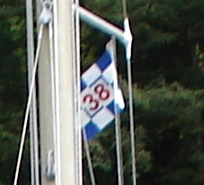
As he said in the email “Note the home made personal burgee. An N code flag with a white insert superimposed with red 38 numerals!!”
So, Roger, would you care to share that design if others like it?
Marilyn
ModeratorKeymasterHiya Adrian –
Glad to show pictures of anyone’s boat at the top of the forum, read this topic to learn how. Thanks to the folks that have already sent me photos, we all can enjoy seeing others boats, randomly selected for each page you view.
Regarding whether its better for a pump to be regularly immersed or kept dry – I would imagine dry. Consider that manufacturers ship the pumps dry and expect them to work perfectly first time they are run… So we cleaned ours carefully, and then left it installed in what hopefully will be a high and dry position forever.
I think the item that benefits most from being dry is the mechanical float switch. The PO noted that the switch had occasionally stuck ‘on’! Therefore, he pulled the pump setup each year to clean it. That sounded like too much work, and risk, to us. With our new 2 pump setup, only the inlet strainer and electronic switch are submerged in the gubbins on a regular basis. We have had the electronic Water Witch get confused by the gubbins one time too, after a big roller tossed around the boat while underway – we had to manually shut off the pump and then later the switch problem fixed itself. We have done our best to clean out the bilge with a wet/dry shop vac too, and keep the cabin floor clean to minimize dirt ingress into the bilge, but somehow the gubbins still multiple down there.
Cheers – Marilyn
ModeratorKeymasterOn Rainshadow, we have two electric bilge pumps.
The main one is a Rule 2000, which is supposed to be the disaster pump. It was installed by the PO, using a mechanical float switch. It’s outlet is routed to the starboard bilge outlet on the as-built boat – that is, the one so close to the waterline that people have problems with back-syphoning when sailing hard on a port tack.
The second pump we added as a maintenance pump. It is a Jabsco ParMax 3 washdown pump, which obviously has a low flow rate. We use this to pump out the little water that accumulates during normal operation. We operate it with the electronic WaterWitch switch, and routed its outlet to a new thru-hull we added to the transom (i.e. – always above the waterline)
When we added the second pump, we mounted the ‘disaster pump’ and its mechanical float switch higher, out of the muck that accumulates in the bilge. The little maintenance pump has a small diameter exit hose (3/4″) and so the idea is that we have limited backflow into the bilge when the hose back-drains after the pump shuts off.
We learned a lot of lessons while getting this installed. If you like the approach we are using, I suggest you read our person blog here to learn from our mistakes before you try this in your own boat. The major lesson we learned is that the Nic 38 must have a deeper bilge than most boats, because its tough to find a little bilge pump that can overcome the back pressure created by the vertical lift required. (i.e. the head height).
Marilyn (Rainshadow)
ModeratorKeymasterI just found some interesting posts on the Cruiser forum on topics covered in this post:
– Conversation about the breather pipe on the Perkins 4-108, see here
– Conversation about the need to ventilate the engine room to better dissapate heat that may affect sensitive electrical components, such as the alternator, see here
ModeratorKeymasterWe purchased our Rainshadow about a year ago. I think the PO did tack on your suggested markup to the asking price. She was on the market for ~9 months before we made our ‘low ball’ offer that thne PO hesistantly accepted. We did a thorough survey of other Nic 38’s for sale at that time (found about 8 of them worldwide), and Rainshadow had one of the highest asking prices. She was very well cared for cosmetically, but she needed new sails and new rigging – Ouch!
Why wouldn’t people pay the asking price when this beautiful, unique, practical boat first came on the market? IMHO, it’s because center cockpit boats are not what you see in Hollywood movies(we’ve had non-sailors ask us, what is that? A sailboat??) Also, ketches are intimidating to some sailors (experienced sailors understand ketch sails and rigging cost lots more than for sloops; inexperienced sailors will be intimidated by the sail plan).
In addition, the Halburg-Rassy Rasmus is a contemporary contender if you are searching for a older center cockpit full keel ketch. They are more readily available, and bring in a lower price. In the US, Camper Nicholsons is not a well known make, which also does not help the price.
We had narrowed our search down to a Rasmus and Rainshadow, both in good shape for their age. The Rasmus was 1000 miles away, but was offered for 35% less than Rainshadow. We made the offer on Rainshadow because she was just a 1/2 days sail away from our homeport. We still paid about 20% more for her than the Rasmus, and we don’t regret that. But, the Rasmus probably would have been a very nice boat too…
I would suggest that if we the Nic 38 to be more valuable, we need to let the market know how great these boats are – i.e. through this website or via sailing magazine articles. As we sail Rainshadow around, she turns many people’s heads, but how many of them will start their quest of purchasing one of these beauties? And pay a premium for her without the knowledge of how great they are?
ModeratorKeymasterMike –
On Rainshadow, we did a similar thing, that is – adding a dedicated fuel polishing loop. You can read the details of it here:
Adding a Fuel Polisher – discusses the fuel polisher system
Cleaning the Fuel Tank – How we took off the fuel tank cover plate and added new fuel pickup lines.To add the new fuel pickup lines to the fuel tank, we took off the coverplate and sent it to a mechanic that had a machine shop who could tap the plate so we could thread in the new fittings. The fittings are just standard copper gas fitting connectors that we bought at the local hardware store. The mechanic also braised on the copper lines that we used as the fuel pickup lines Look at the pictures and read the text at the link I give above for more info about how we did the fuel pickup lines, and you can see if our Rainshadow has the same setup as your boat. Hope that helps.
Marilyn
ModeratorKeymasterI finally scanned the Neco auto pilot manual, you can find it on the Equipment Manuals page.
If this external website is still active, they had some additional Neco documentation scans, including some additional electrical schematics.
ModeratorKeymasterI’ve uploaded the scanned Valient manual to the Equipment Manuals page.
The manual offers no help regarding the parts replacement, but you can see info about correct water pressures.
Ours still works well, so have not messed with it. It does leak at the temperature adjustment valve, depending on temperature setting, so we will need to tear into that someday.
ModeratorKeymasterJeff provided me some photos, which you can see on my Flickr page at Windscreen wiper project on Sea Eagle
ModeratorKeymasterThis is a common request – so I just created a PROTECTED page that lists everyone’s email address. To find out how to access this protected page, send me an email at moderator(at)nicholson38.org (replace the (at) with @). Or check your most recent digest, where I explain how to view that protected page.
And thanks for sharing this website with others!
ModeratorKeymasterAdrian – regarding older “posts” on the subject, I assume you mean emails from the time before this website existed, and no I do not have them. If you send them to me, I make some postings out of them. Or if you have time, feel free to start new topics in this Steering and Rudder category and just paste them in.
Regarding posting photos – alas, that is something this site doesn’t support well. You can read my suggested hacks here.
ModeratorKeymasterWe have the Neco, the PO said that he had it rebuilt by Raytheon (nb: I formerly mistakenly said “Raymarine”, and have since corrected this posting), who are now the owners of what was originally Neco (if I understand correctly). Last year, the purchase surveyor was surprised when the PO said it still worked. The surveyor made some comment like “that would be the only one left working on the west coast (of the US) then”.
We can tell you that our Neco works great. We don’t use it often, and rarely use it under sail because it seems to require a lot of power to run. We have the original documentation, which we could copy if that would help anyone. We don’t have any receipts from the rebuild, so cannot help in understanding which bits required work to keep it running.
Rainshadow also came with a Monitor windvane. We’ve not installed it yet, but it seems all the bits are there and we have the documentation for it. We hope to have a reason to try it next year. The PO said the vane does get in the way of the mizzen, but he would just push the paddle down when it was time to change course, and then reset the paddle again. They used the Monitor for 3 years (in late 80’s) during a passage from PNW (US) to Australia.
They rigged the Monitor so control lines operated the actual helm; they did not connect to the rudder post at the aft deck. So to reinstall the Monitor, we need to pull the helm wheel and reattached a fixture that allows the control lines to steer the helm. The attachment from this fixture to the helm wheel is via a pin that sticks through a hole at top dead center of the wheel near the hub – apparently the helmsman can easily disengage this pin to resume manual control of the helm. We also need to rerun the control lines through the fairleads that lead the lines from the aft deck, along the port side, into the cockpit. I’m sure it will be fiddly to get set up, but the PO said it worked great and was very pleased with it. I doubt he used it much in the last 15 years, though. At least the attachment points on the stern are still there, as are the fairleads on the stancions. We look forward to trying it.
MarilynModeratorKeymasterJeff- that’s interesting about the wiper unit. Do you recall which Vetus unit you bought? Their catalog has several to choose from. Your comment about the two shafts makes me think its the HDMC, but that’s their heavy duty (read most expensive) motor – US$700. For just the motor. Ouch!
Rainshadow’s entire wiper unit and control are missing so I have nothing to compare for sizing. The PO said the wiper just smeared around the salt, and he preferred to use a squeegee. I’m thinking a wiper would be a lot easier than climbing out of the cockpit each time the windshield gets blurry.
If anyone wants to know what the bracket looks like once you take off the motor and arms, I can post a photo.
MarilynModeratorKeymasterJeremy just wrote me another email, and said this:
“That is the answer!!! We never fitted a Neco there, that is where the vent was!. You really must have good ventilation to the engine space. You really should have an extractor fan which then requires a bigger inlet.”Of course, that Nico control has been there a very long time. Maybe not 36 years, but a most of that time certainly. Now we just need to decide, after all these years, whether it really does make any difference to the engine efficiency, or longivity, to not have a dedicated louvre to allow the engine to breath.
Running with the lazerette open is not an option, because our lockers are mostly isolated from the engine room. We could temporarily run with, for example, the floor board over the bilge in the aft cabin open to see how much difference it makes. Of course, we’ve tried that for a few minutes, and the increase in noise overwhelms any other senses, so we put the cover back down again quite quickly. Scary to watch the prop shaft spinning anyway.
ModeratorKeymasterJeremy Lines wrote me an email saying he’s rather surprised we have no engine vent because he thought all boats had one installed at CN. He asked if something else could have been installed in its place by PO. Good question.
Below is a photo of our area under the helm. You can see below the foot rest, we installed a high water alarm (salvaged from home alarm, so a little unsightly, but generally hidden). Above the foot rest, there is the controls for the Nico autopilot, which I thought was original equipment. There is no area that looks like its been filled.
Can anyone tell me where your engine vent is located under the helm?
 ModeratorKeymaster
Many thanks to JG (svGosling) for posting a comment on our personal blog. Others may find his advice useful, so here’s the link to his comment.
ModeratorKeymasterYes, we checked the engine air intake too – the mushroom shaped thing. It was pretty dirty, but not scary dirty.
Under this mushroom cap there is a tube that leads from the engine to the center of the mushroom, that is, it bypasses the filter. We were surprised to find a breather hole in that tube. This tube must have something to do with the engine air usage, and the hole something of a venturi effect. We asked our mechanic about it, and he didn’t have much insight into why the tube would have a big hole that is open to the engine room without any intervening filters, which seems like it could suck unfiltered air directly into the engine. But as you say, the trusty Perkins is still running strong, so…
MarilynModeratorKeymasterThanks Mike – I’ve added the info to our suppliers page: (Click the Suppliers tab near the top of this page, or go to this link to see the discount offering.
ModeratorKeymasterAnyone in the US may want to check out New Found Metals, Port Townsend, Washington. http://newfoundmetals.com/
My friend just put them in her Ericson, and speaks very highly of them. I’ve not compared their available sizes to the Nic 38 sizes.
ModeratorKeymasterArild kindly supplied me with some scanned Mathway Steering gear documentation. You can find it here (5.5MB download as PDF)
This is not the easiest documentation to follow (I can see why Mathway claimed they had no user documentation – this stuff comes from tech service manuals). But you can put some facts together and come up with some very useful info.
First, from the Mathway Steering website, I can see that our Rainshadow has the Mathway LS steering gear.
Second, if you look at the PDF indicated above, read any place they mention the LS steering (ignore the rest), and learn that:
1) The steering bowl and the Bevel box are filled with SAE 30 oil, and then as long as the seals do not fail, they should be fine without maintenance.
2) The Aft End Reduction Gear box are filled with SAE 30 oil and should be checked every 6 months. If the oil seals are OK, should not need refilling, but given they say to check every 6 months, it seems they think these seals will fail.
3) Keep the U-joints, ball joints, and bulkhead bearings well lubed with soft grease.
So I guess will head back to the boat and look more closely at the aft end reduction gear.Does this make sense to people who have been maintaining their Mathway steering? Or has everyone replaced theirs already, as did Adrian?
ModeratorKeymasterI double checked the the dimensions I provided at the top against the sail plan, and they are indeed correct. Mizzen stays’l are huge – on the order of the size of the mainsail.
Here’s how to rig it according to the Nic 38 owners manual:
The mizzen staysail is made of nylon and should be treated generally in the same way as the spinnaker. It can only be used effectively with the wind way on the beam to nearly dead aft. The tack pennant of 1” terylene and about 6 ft long should be permanently attached to the tack of the sail and the sheet should be snapshackled to the sail clew.
1. Ensure the boom is held down firmly by the boom vang.
2. Attach snatch block to aft end of mizzen boom for sheet.
3. Attach tack pennant to weather mainmast capshroud chainplate, leaving the tack of the sail about 3 ft above deck.
4. Pass the sheet over the mainsheet and to leeward and outside of all mizzen rigging, through the sheet block and down to the lee cleat on the aft deck.
5. The halyard should the be taken around the leeside of the main backstay and with the sheet cleated the sail may be hoisted until its luff is just clear of the main backstay. Also see that the sail is not snagged on the windscreen wiper. The sail should be set as high as possible.
6. This sail must be lowered and the halyard and sheet released before tacking or gybing.ModeratorKeymaster[and one more response from Jeff via email:]
I bought thin 3/8 by inch and a half wood strips and screwed these to the overhead with a little epoxy at the screw points ( I used very small #4 tapered screws that were only about a 1/4 inch long and pilot drilled the wood ) . The FRP is not very heavy so the seam and edge connectors are all that hold the panel up .Jeff Avery
CN38 ValkyrieModeratorKeymasterAnd capturing some more from emails: From George Nauman
Jeff,
We have been looking for some sort of headliner for our Nick 38. Did you write to say that you attached the FRD wall panel directly to the underside of the deck fiberglass? The glass below the balsa core on our Nick 38 hull 123 is less than 1/16 thick. So I was wasn’t interested running screws into the core. Your information is very helpful!
thanks
George NaumanModeratorKeymasterCapturing some useful responses that were shared via email: From Jeff Avery***
There is a fiberglass product sold in 4’x8′ sheets (Home Depot or Lowes) that is designed for the walls of commercial kitchens ( wont burn , easy to clean ) that I used for the entire headliner in my CN38 . You can get all the moulding ( seem connectors , inside corner moulding , outside corner moulding etc. ) in the same section of the store .
The whole job cost me about $100 in materials even with my screwing up several pieces . The mouldings screw directly to the overhead , or you can add wood strips if necessary . No glue , no paint and no special tools . This stuff cant rot or mold and I’ve been very satisfied .
[then later, another email said]
I stopped by Home Depot and the name of the product I used for my headliner and wall panels is “FRP Wall Panel” . A 4×8 sheet has gone up to $32.49 .There is another product called “Polywall panel” but it is thinner and Home Depot doesnt carry the trim pieces .
Jeff
S/V ValkyrieModeratorKeymasterOur Nic 38 came with an old, but barely used, North Sails Gennaker, which is an assymetrical cruising spinnaker. The bag says it is for a Landfall 35, so it wasn’t custom made for the Nic 38. But I can tell you it works pretty well.
We measured its dimensions to be:
38′ leach, 41.4′ luff, 21.5′ footThe as-designed Nic 38 Sail plan doesn’t give dimensions for a spinnaker, but does say the fabric wt should be 1.5oz nylon, as expected.
Marilyn and Van – Rainshadow hull #126
-
AuthorPosts