
@voltair
Forum Replies Created
-
AuthorPosts
-
 VoltairParticipant
Hello Derek and John – we are just about managing to keep our Neco alive and functioning, and up till recently all the problems have been associated with the drive and gearbox, relays etc. That bit seems to be working fine at present, but now we have an issue with the rheostat (or whatever it is) that is behind the compass setting knob in the middle of the control unit, and I would like to get a replacement for this component if either of you have one available.
Up till now, I have not dismantled our control unit to find out what is giving the probs, but the symptom is that a small movement of the knob can result in a large alteration of course (as if it is dirty contacts behind the knob). So we set it roughly and then use the trim knob for accurate adjustment. However, I suspect it will really die soon and then I won’t have a spare.VoltairParticipantVoltair’s fridge had been limping along for some time but in 2014, shortly after leaving the Spanish mainland for Ibiza, it turned its toes up for good. We bought a “sealed package” from a supplier on the mainland who arranged to ship it to Ibiza for us, and we did a self installation within one day, putting the new compressor/condenser under the fridge box just as it had been previously. The new condenser seems to work a lot better than before, and I was able to do away with the computer fan blowing air at the condenser (thus saving an amp), but the new compressor uses slightly more juice than the old one did (5-6 amps), though it is a little less demanding on startup than the old one was. We rate it a success, since this Mediterranean cruising is new to us, and we have mainly had cool if not cold beer ever since, even with the cabin at 35C it was still working OK. Further improvement could be made by changing the insulation around the original cabinet, which is patchy and poor, but difficult to get at, especially behind the cabinet. It has NOT solved the problem of providing 5A x 18hr = 90Ah energy per day (75% duty cycle) with most of this being at night, without flattening even new batteries of the highest calibre. Can send you more detail if you need it. Total cost was about €500 from memory.
VoltairParticipantYes, it fitted very well, and with the new holding tank behind it, we are enjoying the summer in Ibiza at present.
VoltairParticipantNot sure if we have a fix for this yet, but, like you, we have acquired an 18″ wide reclaim one, which we are hoping will fit.
VoltairParticipantOn Voltair we have now installed a purpose built stainless tank where the cubby-holes were in the heads, that discharges under gravity through the existing heads through-hull. We managed to get approx 48 litres capacity, without any new pumps and only one valve to switch. Because the vacuum heads system pumps such a lot of seawater along with the detritus, we figure that most of the tank will be full of water (once it’s settled a bit). So we have arranged for an upstand pipe inside the tank to about 3/4 height, so that any surface liquid can flow down there and away to sea without discharging anything embarrassing. The switching valve changes betweeen discharging this “water” and fully discharging the tank. The skin-fitting valve means we can contain the whole lot if constrained to do so (though actually it leaks quite badly). The vent pipe is connected to the wash-basin waste, which is on the waterline, so it won’t vent well on port tack (but who cares). I’ve put a loop trap in the basin waste so the vent pipe doesn’t cause smells to come in. The vent pipe is also sealable, so that we can forcibly pump the waste through the tank if gravity doesn’t do the job for us. Total cost was around £800 including 2 round trip airfares to Portugal to transport and install the tank and associated plumbing. I have the tank profile design to hand if anyone wants to try something similar.
VoltairParticipantVoltair’s stbd tank is water and the port tank diesel. Whoever installed them used ordinary gate valves on the pipes which connect them to their main tanks, which are a real pain, since they are very difficult to shut off properly. To drop the water down into the main tank (or shut the valve after) requires a gorilla with very long arms to swing under the battery box and reach the valve. Would have been much better with 1/4 turn ball valves, but maybe these weren’t so available in 1972.
VoltairParticipantWe were thinking of using the space behind the cubby-holes in the heads to fit a small one…. but above sea-level, so it could self-drain to sea when you open the sea-cock.
The problem is, Voltair is in Faro, I am in UK so I can’t measure the space until we next go out there…… unless someone already tried this and knows how big the space is…
VoltairParticipantThinking about your point regarding pulling fuel up from the main tank, I installed an outboard motor squeeze-me in the fuel line just under the aft basin fitting. This has a one-way valve in it, which stops the fuel running back if you have any air leaks. Since we tend to have been sailing in places where Eberspacher engineers can’t easily be found, we also uprated our controller to the digital one where you can cancel all the fault codes….. no more “3-strikes and you’re out” anymore now. Unfortunately we only did this AFTER we had paid a Swedish one to fail to cure the ignition problem that I later cured myself.
VoltairParticipantThat’s ironic – you using DERV fuel for heating and Red for driving! We too have an Eberspacher 3kw unit which worked fine until we caught diesel bug in Norway. The season after that the tubular sintered bronze filter-wick thingy that surrounds the igniting hot pin got bunged up with what I took to be coked on bio-debris. I changed that and it has worked fine for a couple of years. However, we recently had another bout of “green jelly” in the tank, so we may have probs when we start using the heater again. With the boat in Portugal at the mo, this may not be for a while!
VoltairParticipantMay your time spent imitating a small monkey be repaid with a positive result!
VoltairParticipantHi Trevor – sorry – haven’t looked at the website for while. What we did when changing units was simply to get everything (wheel, rudder, insides of the Neco gearbox which contains the contacts) in the straight ahead condition, and then assemble it in that condition, with the chain put on without moving the gearbox or drive tube. And it worked first time. I never had to adjust a limit switch at all. John K
VoltairParticipantI have just listed Vols 4, 5 and 6 of Den Norske Los (Coastal Norwegian Pilot) on Amazon at the bargain price of £25 each volume (cost over £40 each new when we were over there). However, it was really difficult to get them onto Amazon and I don’t know if they will display properly. Anyone interested without a middle-man?
Also available is an excellent Harbour guide for the E coast of Sweden, Aaland (in the middle) across to Finland’s coast. Quite rocky, but great cruising for the summer! £20 if you like.VoltairParticipantBut all this is far away from the original topic, protection of the alternator. Yes, we also have the problem of water dripping from the under-floor crossmembers. If we suspect we are going to get a lot of rain, we just put some sheet plastic over the front of the engine when we are shutting things down to leave the boat.
Having come back from the Pub, we are now considering some kind of lateral drain channels, maybe 6″ long and 2″ tall, going through the side lockers and exiting the hull at a level about 4″ above the floor (when on an even keel) with hinged flaps to allow water out but not in. These would be ducted through to the internal cockpit walls at the same height. In this case, we might not need to raise the cockpit floor at all, because once the water got high enough in the cockpit, (or the boat was heeled a bit), it would mostly run out of the downhill side into the sea. All the old sailing ships used to have them, I gather. But we would need to use the taller toe-boards to block the companionways, which our previous owner had made under recommendation from the authorities.
VoltairParticipantI think the reference to flammability and vulnerability of all these drainpipes was probably a comment we made long ago when Peter in the Med was re-doing his drains.
On Voltair, we are so concerned about our drains that we shut them off completely. In our opinion, the dia of the original drains are completely inadequate, and the cockpit floor is also at least 2-3 inches lower than desirable to give adequate freeboard above the drain level. (or else Voltair is 2-3 inches lower in the water than she should be!) If ever we got a massive wave aboard that filled the cockpit, it would now drain into the cabins and thence to the bilge. We hope we could pump it out from there, but if there were one or two more waves that followed the first, we feel sure the yacht would be depressed by some inches and the original drains (were they open) would then cause the vessel to sink rather than drain. Therefore we are actually considering raising the cockpit floor by about 4 inches (with all the horrible hassle that will entail) and fitting 2 x 3-inch diameter drains on each side of the cockpit, so that in the event of a real dump, we have a chance of draining the water back to sea rather than sinking.
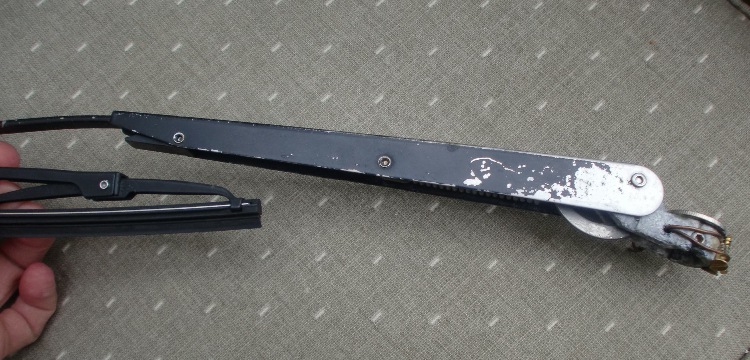
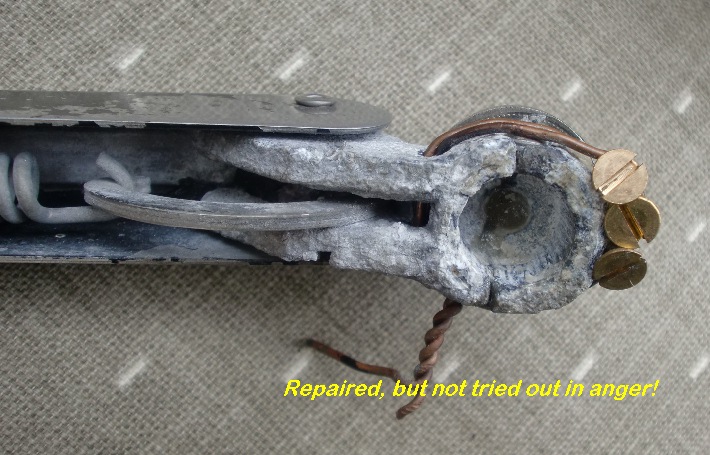
But we are only considering this over a pint at the pub tonight…. with Voltair far away in Portugal, making it happen is somewhat further away as yet.VoltairParticipantContinuing the thread from last year, Voltair’s screen wiper motor is working fine, but the mazak casting in the arm which locates onto the splined drive has broken in half. Has anyone got a redundant Hepworths-type arm we could have/buy? Or just the casting since we actually have a functional arm, just the female splined bit has bust (approx 13.5mm I/D and it looks like parallel rather than tapered splines). I’d have expected there to be a nut on the end of the spindle to retain it all, but ours has a allen-type grub screw in the side which bears on the male drive.
 VoltairParticipant
The rudder on Voltair was a writeoff during our catastrophe in Scotland in winter 2000/1. It was rebuilt for us by Baltic Wharf boatyard who did the repairs in Totnes, Devon, and I don’t remember seeing the ?bronze? structural member around which the new glass was laid up, before it was laid up. However the guy who owned the boat before us did have experience of “dropping” the rudder out – he said it was the most terrible job and that you need a lot of height to do it! I think ours is split with a coupling, which you can see through the door in the aft cabin.
VoltairParticipantCould we have one with the waterline length on it instead? Would be a lot cheaper when you get that Marina guy ask how long the boat is!
VoltairParticipantIt was a year or two since I did it: we were in Norway at the time near Haugesund and we found a friendly workshop “Royksund Mekaniske Verkstad” who allowed us to moor alongside and use their tools. I seem to remember it was the ball joint nearest the gearbox that had failed, so I took the radius arm off the gearbox, and that gave me enough leverage (after unlocking the locknuts) to unscrew the link off the far balljoint. Then I was able to take the link and duff joint and radius arm into the workshop and give it some serious abuse. I don’t remember using an extractor, just a large vise, a heavy hammer and an immense stilson. I remember getting a fearful amount of black rust and crud on their beautifully clean epoxy-painted floor! I don’t think we ever changed the other ball-joint, but we carry the spare around “just in case”
VoltairParticipantOnce its all apart, you will probably want to renew the two track rod ends (one RH thread, one LH). We found ours were the same as used on Leyland “Freight Rover” vans, and were cheaply obtained at our local motor spares company.
VoltairParticipantYou have hit on a topic that will of interest to Robin and me over the next couple of years. We will have owned Voltair for 10 years next season and probably will be selling her to move on to the next project. When we were buying, we decided to buy the dearest one we looked at, whose owner was an engineer and who had got the boat up to Board of Trade chartering standard. And since buying it, we’ve fixed all the things that he had never managed to fix, so now she is better than ever! New, they were about £16K. At 30 years old we paid nearly 3x that much, so at 40 years old, I reckon the price should be nearer to £60K than £55K. Does that include the extra £5-10K that Trevor of Ronar is speaking about or do you think we would be under-selling?
VoltairParticipant1). We found some P-section rubber which we glued to the top of the screen and then dropped the lid onto it. This made a really good seal and has not leaked (or seen the light of day) since we fitted it in 2002. And an awful lot of water has hit it in the meantime! If you get stuck I can probably find the suppliers name from our records.
2). I should be really careful about machining out the spindle hole if it goes through the glass! Or does it go above the glass?
VoltairParticipantI’ve been thinking of doing the same on Voltair. I’ve even got the valve. In your case, is your pump a manual Henderson/Whale pump or is it some kind of electric device? Did you put the new valve between the hull-fitting and the pump in a horizontal pipe run, or between the pump and the bilge in a vertical run? Do you think the design you installed is OK in either horizontal or vertical pipe? If you have a manual pump, did you have a look inside the bilge pump and see the condition of the the one-way valves built into the pump? I figured the valves in there ought to do the job for you….. so didn’t install anything yet. But we haven’t had any big port tack sessions since we had the major problem in the Skagerrak in 2007….
VoltairParticipantThanks for that – so its not rigged on a “stay” at all. I wonder why it’s called a staysail. I also wonder why the area is listed 10% smaller than the dimensions would predict. I guess the halyard coming from the top of the mizzen has to bet set quite loosely under the main backstay so the sail and halyard blow to leeward away from the backstay. Presumably the luff on a real one has no bolt-rope or anything sewn to it – its just like a spinnaker luff/leach is it? Maybe we can have another go with the dinghy mainsail, but make the leach the luff, (and the head the tack) so it will curve and set better. Does anyone have a picture of one set?
VoltairParticipantAre you sure those dimensions are correct? They describe a large isosceles triangle with area 241 sq ft and I have no idea how it could be rigged……. A picture would be wonderful. We did have a go with a mainsail off a GP14 on Voltair, but couldn’t really figure out how to rig it to advantage. We’re off for another visit to her on 26th Sept, so we could have another go if you supply a bit more info. John K
-
AuthorPosts